

.png)
Hello, and happy Tuesday! Two months ago, Every’s head of growth Austin Tedesco tried Codex and found it more frustrating than any other AI tool he’d used. Last Thursday, at our Codex Knowledge Work Camp, he and CEO Dan Shipper showed more than 250 paid subscribers how OpenAI’s Codex desktop app has since become Austin’s daily driver—handling everything from email triage and go-to-market planning to KPI tracking and recruiting. Read to the end for how to review business documents with Austin’s compound knowledge plugin.—Kate Lee
Was this newsletter forwarded to you? Sign up to get it in your inbox.
Signal
Coding apps are the new operating system for knowledge work
What happened: OpenAI’s Codex desktop app may have started life as a product for senior engineers pair programming with AI, but these days it’s equally good for powering other types of knowledge work. Every’s head of growth, Austin Tedesco, now runs roughly 80 percent of his daily workflow through Codex—a tool that, at our Codex Knowledge Work Camp, he said was “trash” for non-engineers just three-to-six months ago.
Why it matters: OpenAI, Anthropic, and Cursor are all racing to ship a unified product for handling code and knowledge work, and they’re converging on a single standard: an agentic terminal or chat interface with a left-hand project sidebar, plus connections to all the tools you already use like Gmail, Slack, Notion, and Stripe. These connections, for many non-engineers, were the missing piece of the puzzle.
What it means: Switching between ChatGPT and Claude based on the models’ personality differences might become a less-common occurrence. Instead, your desktop AI app has your API keys, your project files, and your daily workflows. Businesses, especially, with custom skills and plugins and months of company data in Codex won’t casually swap to Claude Code or Cowork next quarter—and vice versa.
Watch for the desktop apps to converge further on shared patterns beyond project folders that load themselves and plugin connectors to your most-commonly used tools. These new patterns may define the next decade of office software.
What to do this week:
- If you’ve been working in the web interface, download one of the desktop apps—Codex or Claude Code/Cowork—and spend a session there. The work feels different once you’re outside the browser tab.
- If you’re already on a desktop app, poke around its integrations and capabilities section. There’s almost always something useful lurking, like Anthropic’s design and marketing plugins, or Codex’s PDF creation skill. Pick one and try it.

Write at the speed of thought
That gap between your brain and your fingers kills momentum. Monologue lets you speak naturally and get perfect text 3x faster, and your tone, vocabulary, and style is kept intact. It auto-learns proper nouns, handles multilingual code-switching mid-sentence, and edits for accuracy. Free 1,000 words to start.
Now, next, nixed
Now: Documents written for both humans and agents. In the past, anything you wrote at work fell into one of two buckets: polished prose for people or structured data for machines. Agents are the first readers that need both. At Every, our guides on compound engineering and agent-native architectures exemplify this hybrid.
Next: Documents that write back...
Become a paid subscriber to Every to unlock this piece and learn about:
- How the review step in compound knowledge keeps agents aligned your company strategy
- The prompt that gets an agent to design your automations for you
- Why the chat window is the wrong place to sign off on an agent’s work

What is included in a subscription?
Daily insights from AI pioneers + early access to powerful AI tools
 Front-row access to the future of AI
 In-depth reviews of new models on release day
Playbooks and guides for putting AI to work
Prompts and use cases for builders
In-depth reviews of new models on release day
Playbooks and guides for putting AI to work
Prompts and use cases for builders
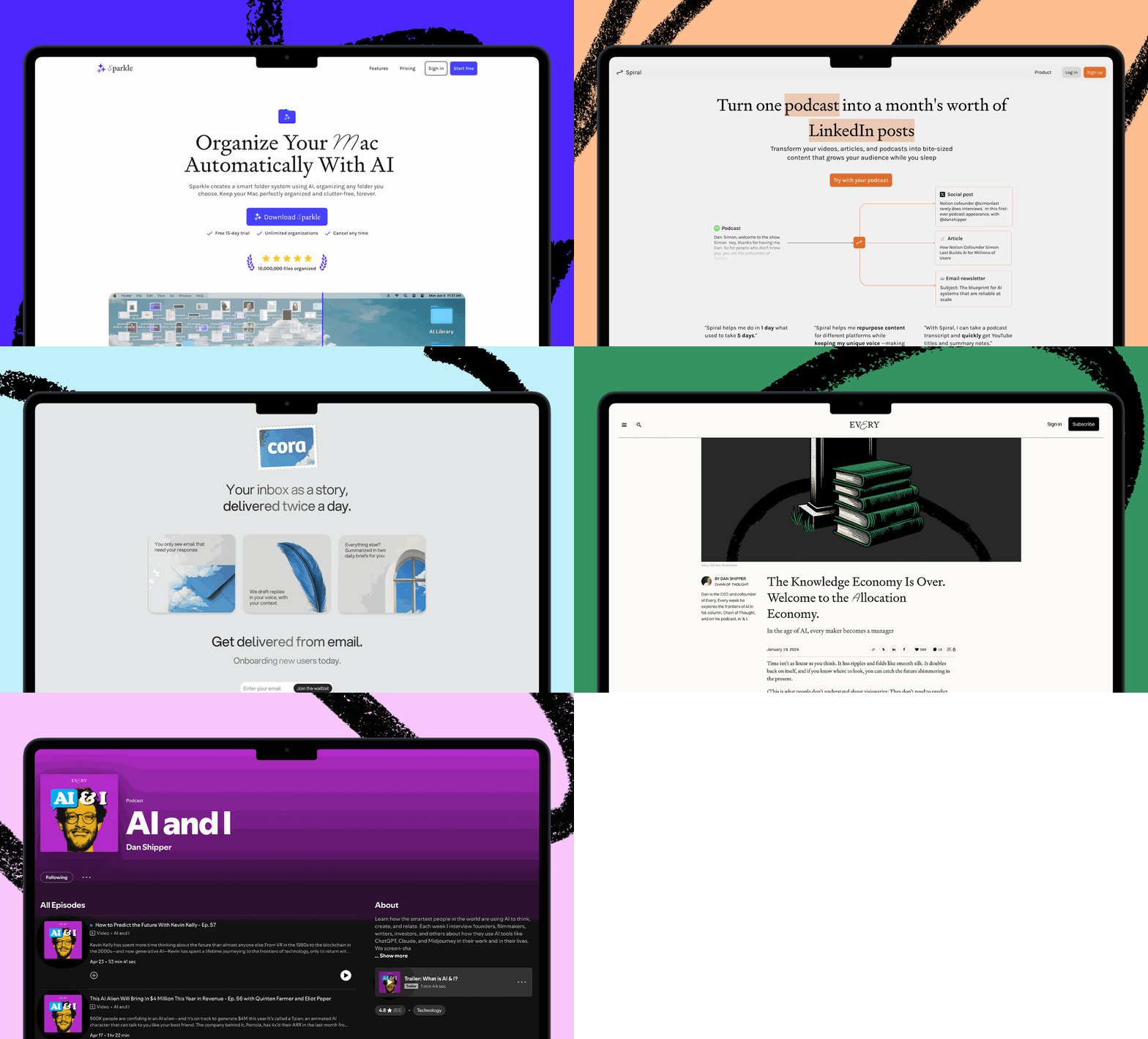
 Bundle of AI software
 Sparkle: Organize your Mac with AI
 Cora: The most human way to do email
 Spiral: Repurpose your content endlessly
 Monologue: Effortless voice dictation for your Mac